
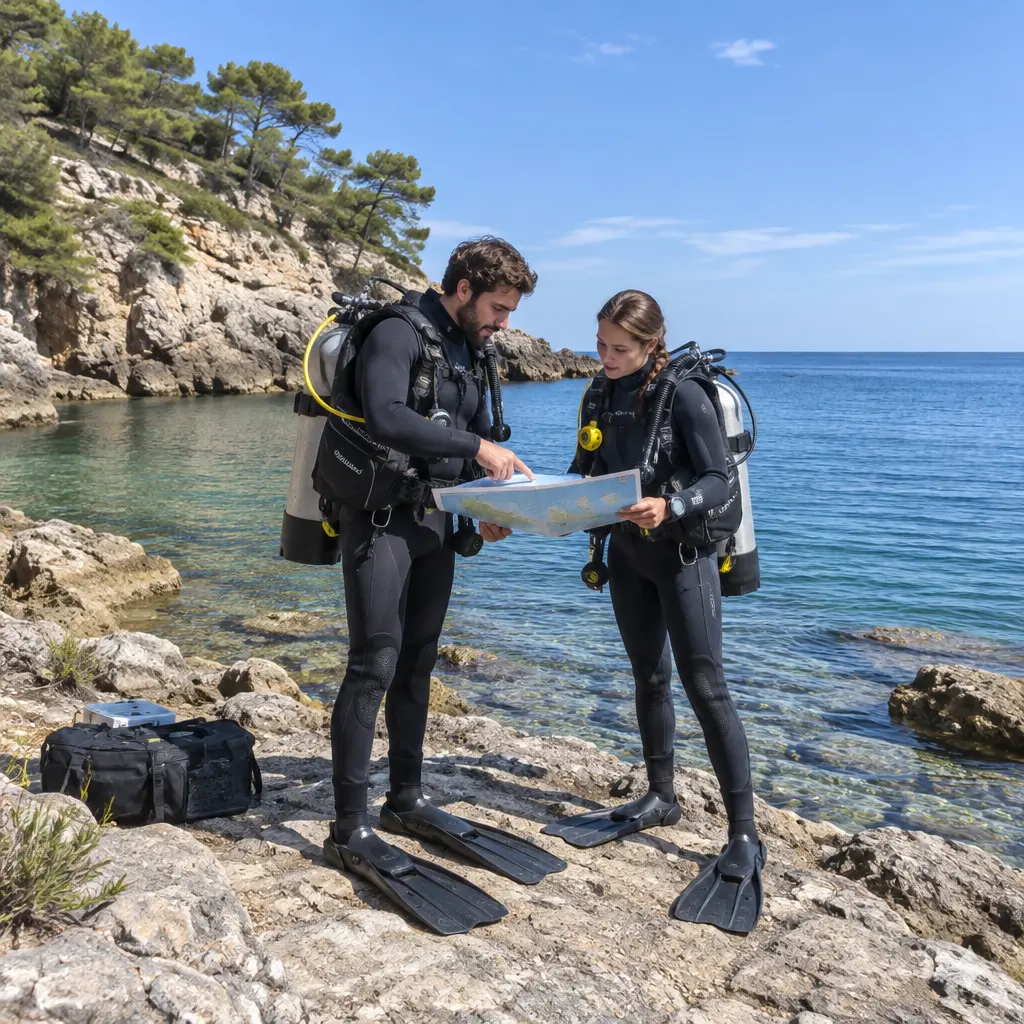
Advanced deep diving exposes divers to elevated nitrogen partial pressures, which can impair judgment, coordination, and decision-making before obvious warning signs appear. Nitrogen narcosis is a pressure-related impairment rather than a predictable “depth limit” that affects every diver identically. Managing it beyond ordinary recreational depths therefore means reducing exposure, choosing appropriate gas and equipment, planning for failures, and using training and conservative ascent procedures—not trying to build tolerance or relying on a single depth threshold. The U.S. Navy Diving Manual and Divers Alert Network (DAN) describe narcosis as a potentially serious operational hazard; meanwhile, technical-diving guidance treats gas selection, workload, and emergency response as interconnected controls.
Nitrogen Narcosis Risk: Pressure, Symptoms, and Variability
Nitrogen narcosis is a reversible alteration in mental and motor performance associated with breathing gas at increased ambient pressure. “Martini’s law”—the informal claim that each 10 metres (33 feet) of seawater produces the effect of one alcoholic drink—is not a validated clinical measure and should not be used for dive planning. Susceptibility differs among people and can change with stress, fatigue, cold, illness, task load, and dive conditions. DAN notes that narcosis commonly becomes noticeable around 30 metres (100 feet), but effects may occur shallower and may become more consequential as pressure rises.
At depth, the diver breathes gas at a pressure proportional to the surrounding water pressure. In a simplified model, nitrogen partial pressure rises with depth when breathing air, increasing the potential for narcotic effects. Symptoms may include euphoria, anxiety, slowed thinking, impaired judgment, poor coordination, and fixation on a task. A diver may not recognize their own impairment, making team observation and conservative planning important.
Depth and partial-pressure exposure
Ambient pressure increases by roughly one atmosphere for every 10 metres (33 feet) of seawater. At 40 metres (130 feet), pressure is approximately five atmospheres absolute; breathing air there produces a nitrogen partial pressure near 4 atmospheres. These figures illustrate exposure, not a precise prediction of an individual diver’s impairment. Depth, duration, breathing-gas composition, and the diver’s condition all matter.
Why impairment is difficult to self-assess
Narcosis can weaken the very judgment needed to identify it. A diver may feel unusually confident while making slower or less reliable decisions. Complex navigation, equipment handling, gas sharing, or emergency problem-solving can become harder, particularly when combined with cold, current, poor visibility, or high workload. The U.S. Navy Diving Manual and DAN both emphasize that depth-related impairment is a safety concern because it can compromise performance, not merely comfort.
Dive Planning Controls Nitrogen Narcosis Exposure
The most dependable way to reduce narcosis risk is to limit exposure and avoid dives that exceed a diver’s training, equipment, or team capability. A plan should account for maximum depth, time, breathing gas, decompression obligations, gas reserves, environmental conditions, and contingencies. Technical dives require formal training and procedures; this article is educational and is not a substitute for instruction, a dive-specific plan, or guidance from a qualified instructor or diving medical professional.
Depth limits and conservative objectives
A maximum operating depth is a planning boundary, not a guarantee that a dive is safe below it. Recreational agencies set limits that vary by certification, jurisdiction, and course. Beyond those limits, divers should not simply extend a recreational profile: technical diving adds decompression, gas-switching, equipment, and emergency-management demands. Select a depth that keeps the team’s workload manageable and leaves room to respond to problems without exceeding training or planned gas and decompression limits.
Gas choice: air, nitrox, and helium-based mixtures
Enriched-air nitrox replaces some nitrogen with oxygen, but at the same depth it does not make the nitrogen that remains non-narcotic. Its principal benefit is reducing nitrogen exposure for a given breathing-gas pressure and dive profile, subject to oxygen exposure limits; it does not make a deep dive automatically safer. Helium-containing mixtures, such as trimix, can reduce the proportion of nitrogen in the breathing gas and are used in appropriately trained technical diving to manage narcosis and gas density. However, helium introduces additional planning and operational considerations, including oxygen toxicity, decompression strategy, gas logistics, thermal effects, and the possibility of hypoxic gas at shallow depths. Gas selection must follow recognized training, analysis, labeling, and dive-planning procedures.
Workload, environment, and team readiness
A technically sound gas plan cannot eliminate risk if the dive adds excessive task loading. Current, cold, poor visibility, difficult entries, equipment problems, and unfamiliar procedures can magnify the consequences of impaired judgment. Teams should agree on depth and time limits, communication signals, gas checks, turn pressures, lost-diver actions, and abort criteria before entering the water. Rest, hydration, appropriate thermal protection, and postponing a dive when ill or unusually fatigued are practical risk controls, not optional performance enhancements.
Recognizing and Responding to Narcosis Underwater
Because individual divers may not identify their own impairment, response planning should emphasize observable behavior and simple, rehearsed actions. A buddy who notices confusion, unusual euphoria, poor coordination, or failure to follow an agreed procedure should communicate clearly and prioritize reducing exposure. The response must remain within the team’s training and the dive plan, especially where decompression obligations make an immediate ascent unsafe.
Buddy observation and task simplification
A buddy check can reveal changes that the affected diver misses: delayed responses, fixation, disorientation, or difficulty completing familiar tasks. Use agreed signals and short instructions, avoid introducing unnecessary tasks, and maintain contact. If the diver does not promptly return to reliable performance, the team should follow its preplanned response and end or modify the dive as training and decompression requirements permit.
Ascent as a response—and its limits
Narcosis generally improves as ambient pressure decreases, so moving to a shallower depth is a common response when it can be done safely. But “go up” is not a universal instruction: a decompression diver may have mandatory stops, and an uncontrolled ascent can create serious additional hazards. Follow the dive plan, preserve required decompression, control buoyancy, and use established team procedures. If a diver is in immediate distress, prioritize emergency protocols and obtain professional medical advice after surfacing.
Training, Equipment, and Operational Safeguards
Beyond recreational limits, risk management depends on demonstrated competence rather than confidence alone. Technical-diving training addresses staged decompression, redundant systems, gas management, team procedures, and emergency drills. Training agency standards differ, so divers should use a recognized program matched to the planned environment and equipment, and should not treat online guidance as authorization to attempt a deeper dive.
Gas analysis and equipment discipline
For mixed-gas diving, each cylinder must be correctly analyzed, labeled, and matched to its intended depth and use. Divers should verify gas identity and oxygen fraction, confirm computer and decompression settings, and maintain the redundancies required by their training and plan. A mislabeled or incorrectly selected cylinder can turn a narcosis-management strategy into a separate life-threatening gas error.
Practice, abort criteria, and incident learning
Rehearse equipment failures, gas switches, lost-buddy procedures, and communication before undertaking complex dives. Set clear abort triggers—for example, deteriorating conditions, unexpected gas consumption, equipment malfunction, or a team member failing to perform reliably. DAN’s annual diving-incident reporting and the U.S. Navy’s operational guidance underline the value of learning from incidents and near misses; recording what happened can help divers and teams improve future plans without normalizing preventable exposure.
Practical Risk-Management Checklist
Before a deep or technical dive, use a structured review rather than relying on an impression that the team is “comfortable with depth.” The following checklist is a prompt, not a replacement for formal training or a dive-specific procedure.
- Confirm that every diver has current training and experience for the planned depth, gas, decompression, and environment.
- Set conservative depth and time limits, and define conditions that require the team to turn or abort.
- Choose breathing gases through qualified training and formal planning; verify cylinder contents, labels, and computer settings.
- Review gas reserves, decompression requirements, emergency gases, team roles, communications, and lost-buddy procedures.
- Assess fatigue, illness, stress, cold exposure, current, visibility, and task loading before committing to the dive.
- Agree on how teammates will recognize impairment and what actions are appropriate within the dive plan.
- After the dive, discuss any unusual behavior, near miss, or unexpected workload and update training or procedures as needed.
Conclusion: Manage Exposure, Not Perceived Tolerance
Nitrogen narcosis risk is shaped by pressure, gas composition, individual variability, and the demands of the dive. Its most dangerous feature is that impaired divers may not recognize their own reduced judgment. Conservative depth planning, appropriate training, carefully selected and verified gases, manageable workload, buddy observation, and rehearsed emergency procedures work together to reduce risk. Divers considering depths beyond recreational limits should seek formal technical training, follow recognized standards, and be prepared to postpone or cancel a dive whenever the plan or conditions exceed the team’s capability.
A useful next step is to review current guidance from DAN and the relevant training agency, then discuss a specific dive plan with a qualified instructor. No single gas, depth number, or experience level removes narcosis risk.
Sources: Divers Alert Network, “The Effects of Nitrogen Narcosis,” https://dan.org/health-medicine/health-resources/diseases-conditions/nitrogen-narcosis/; U.S. Navy, U.S. Navy Diving Manual, Revision 7, https://www.navsea.navy.mil/Portals/103/Documents/SUPSALV/Diving/US%20Navy%20Diving%20Manual%20Rev%207.pdf; National Oceanic and Atmospheric Administration, NOAA Diving Manual: Diving for Science and Technology, https://www.omao.noaa.gov/diving-program/noaa-diving-manual; Divers Alert Network, Annual Diving Report, https://dan.org/safety-prevention/diver-safety/diving-incidents/


