Safety protocol rigor in emergency ascents means learning and repeatedly rehearsing a planned, controlled response to an out-of-air or other life-threatening diving emergency—not simply swimming upward as fast as possible. Practice can make essential actions more familiar, but it cannot replace training, equipment checks, a breathing gas supply, or sound judgment. The distinction matters: the U.S. Centers for Disease Control and Prevention (CDC) reports that drowning is a leading cause of unintentional injury death, while diving emergencies can also involve decompression illness and lung overexpansion injuries. This guide explains how protocols, supervised skill practice, buoyancy control, and post-dive review fit together, and why ascent drills should be performed only within an appropriate training program.
Emergency ascent practice and safety protocol rigor
An emergency ascent is a diver’s controlled return toward the surface when continuing the dive is no longer safe. It is not one universal maneuver: the appropriate response depends on the emergency, depth, available gas, equipment, training, and conditions. Divers Alert Network (DAN) emphasizes that emergency decisions should prioritize breathing, buoyancy, and a controlled ascent, while avoiding breath-holding. A diver should follow the procedures taught by a recognized training agency and the dive plan rather than improvise a drill based on an article.
Rigor means that training is planned, supervised, repeated to a defined standard, and followed by feedback—not that divers are pushed into stressful or hazardous simulations. A useful protocol identifies the trigger to end the dive, the signal to a buddy, the available ascent method, the required buoyancy actions, and when to seek medical assessment. The exact steps differ across recreational scuba, technical diving, and surface-supplied operations.
Why repetition helps—and where it stops helping
Rehearsal helps divers recognize a problem and retrieve familiar actions under pressure. In skill learning, repeated practice can improve consistency, but performance in a calm training setting does not guarantee sound decisions in a real emergency. For that reason, drills should build competence progressively, with an instructor observing control and stopping practice if a diver becomes distressed.
The goal is not to make an emergency ascent automatic regardless of circumstances. It is to make foundational actions—such as signaling, maintaining breathing, controlling buoyancy, and staying with a buddy when feasible—more reliable while preserving the ability to adapt to the actual situation.
Controlled ascent skills and emergency response
A controlled ascent is a managed movement toward the surface at a rate and in a manner appropriate to the diver’s training, depth, gas, and circumstances. The Professional Association of Diving Instructors (PADI) and other training organizations teach ascent procedures as part of broader buoyancy and emergency-management skills. The “right” procedure is therefore not a single speed or sequence for every incident.
Several related emergency categories help explain why protocols differ. These include a normal abort of a dive, an ascent with a functioning gas supply, a response to depleted gas, and a response to a buoyancy or equipment problem. They are not interchangeable drills. In particular, a simulated loss-of-gas exercise or emergency swimming ascent can expose a diver to serious risk and should occur only when explicitly prescribed and supervised by a qualified instructor under agency standards.
Aborting a dive before it becomes an emergency
An aborted dive is a precautionary end to the dive because of a concern such as deteriorating conditions, discomfort, equipment trouble, or a buddy’s request. It is often safer to end a dive early than to wait until a manageable concern becomes an urgent gas or buoyancy crisis. Divers should agree on communication and turn-around or exit criteria during the briefing, then carry out the planned exit while monitoring one another.
This category is important because not every ascent is an emergency ascent. Treating every return to the surface as a race can encourage poor buoyancy control and unnecessary risk. A planned, controlled exit remains the default whenever conditions allow.
Gas-supply problems and buddy response
A gas-supply emergency is a situation in which a diver cannot rely on their normal breathing supply. The response depends on training, equipment configuration, and whether a buddy can provide gas. Divers should know their team’s donation method and practice it in a controlled setting, using the equipment and procedures for which they are qualified. A diver should not attempt an unfamiliar technique in an emergency merely because it appears in a general guide.
DAN’s incident analyses repeatedly identify interacting factors—such as gas-management problems, separation, equipment issues, and delayed decisions—rather than one isolated cause. This supports practicing team communication and early problem recognition alongside any ascent skill. It does not establish that rehearsal alone prevents incidents.
Buoyancy, breathing, and ascent control
Buoyancy control is the ability to manage a diver’s position in the water using lung volume, buoyancy equipment, and weighting within the limits of training. During ascent, expanding gas in the lungs and buoyancy equipment can affect rate of travel. Divers are taught not to hold their breath while ascending on scuba because expanding gas may injure the lungs; they should continue breathing and follow their training for buoyancy management.
The U.S. Navy Diving Manual describes decompression and pressure-related hazards in detail, while recreational agencies teach ascent procedures suited to their curricula. No one should treat a generic rate or a memorized count as a substitute for the current training standard, depth limits, computer guidance, or an instructor’s direction. A visual aid could use a simple flowchart—recognize the problem, signal, select the trained response, control the ascent, and obtain help afterward—while clearly noting that the actual branch depends on the emergency.
Supervised drills, practice design, and performance checks
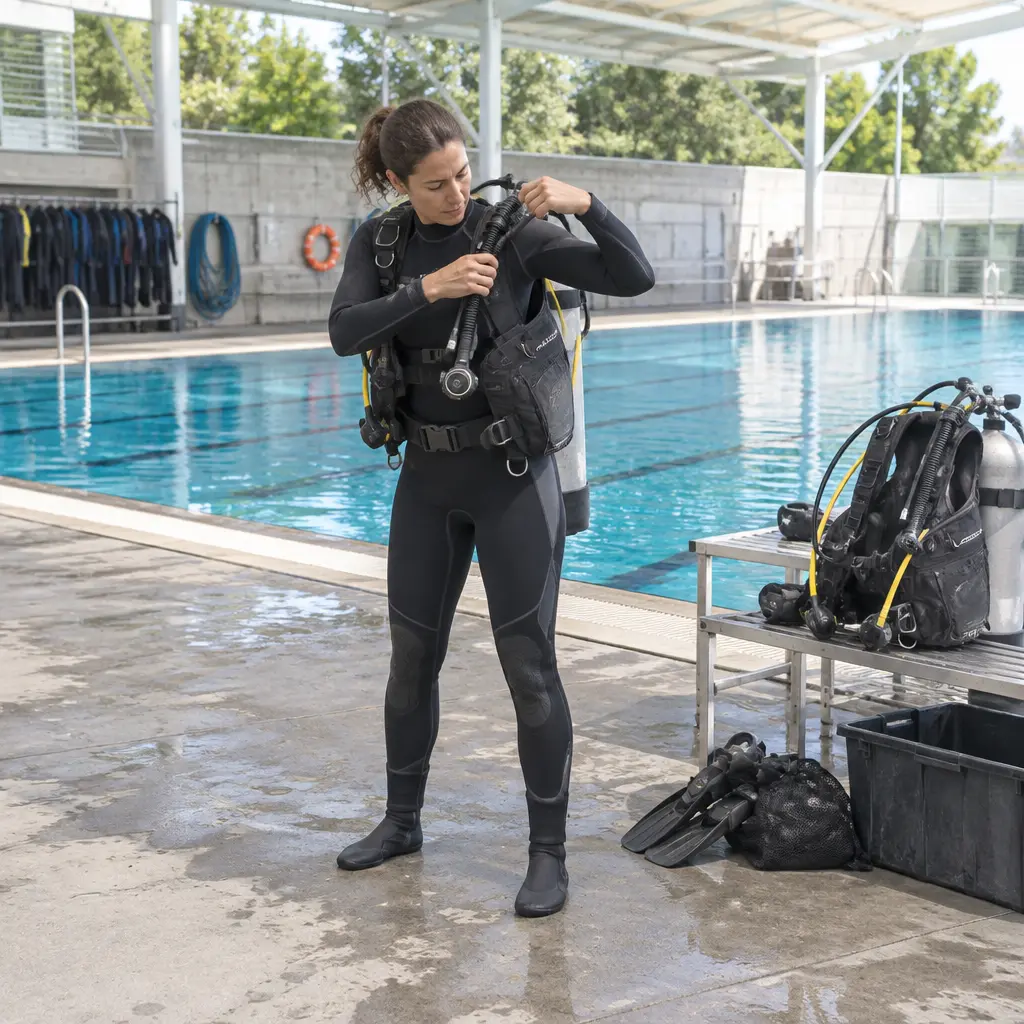
Effective practice is structured and proportionate to the diver’s certification and experience. It starts with dry explanations and equipment familiarization, then progresses to in-water work only under qualified supervision and within the training agency’s limits. Repeating a task until it feels familiar is not enough: instructors should confirm that the diver can perform it without losing breathing control, buoyancy, awareness, or contact with the team.
Progressive practice rather than surprise stress
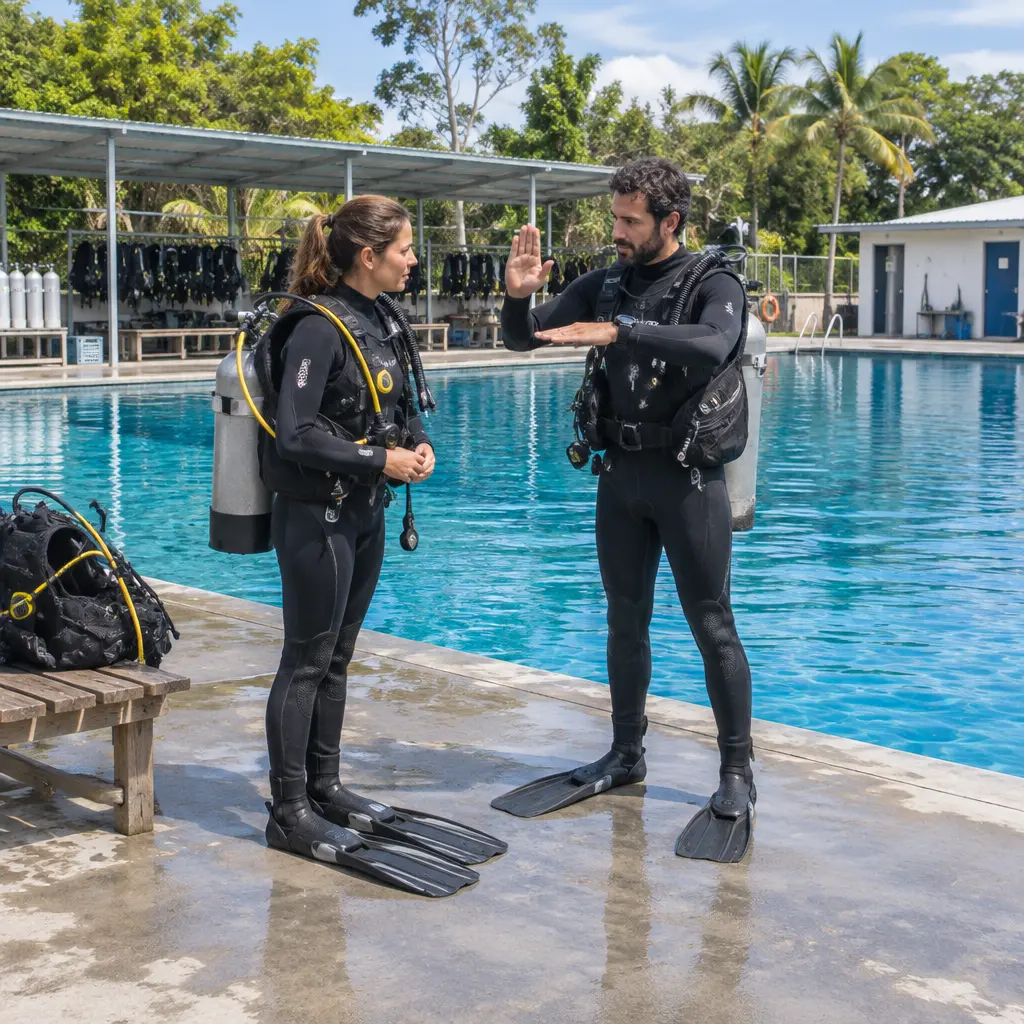
Progressive practice introduces one manageable challenge at a time. A diver might first rehearse signals and equipment location on land, then perform appropriate basic skills in a controlled pool or confined-water setting, and only later practice approved scenarios in conditions suitable to the course. The instructor should explain the exercise, define stop signals, maintain close supervision, and end the drill if safety margins are reduced.
Surprise, panic-inducing, or breath-hold exercises are not a sound shortcut to “muscle memory.” They can create the very hazards training is intended to prevent. Emergency procedures should be practiced only as authorized by the diver’s certification program and with the required safety support.
Observable criteria and debriefing
A useful skills check looks for observable behavior, not just confidence. Depending on the drill, an instructor may assess whether the diver recognized the cue, communicated clearly, maintained breathing, controlled buoyancy, followed the assigned team procedure, and stopped when directed. These criteria should be drawn from the applicable agency standards rather than invented as a universal checklist.
After practice, a debrief can identify what worked, what felt confusing, and what should be repeated at a lower level of difficulty. Logging training dates, conditions, instructor feedback, and refreshers helps divers recognize when skills have become rusty. A chart in a training record could track practice sessions against instructor-validated criteria; it should not be presented as proof that a diver is prepared for every real-world emergency.
Risk evidence, real-world context, and limits of the data
Diving emergencies are uncommon relative to the number of dives, but their consequences can be severe. DAN’s annual diving incident and fatality reports analyze reported cases and discuss recurring contributing factors. Such reports are valuable for identifying patterns and improving education, but they are not a complete census of every dive or near miss; reporting practices and available case details vary.
The CDC’s drowning statistics provide broader water-safety context, not a measure of scuba-specific ascent risk. It would be misleading to use general drowning totals as proof that one particular ascent drill works. The stronger practical conclusion is narrower: emergency readiness should combine appropriate training, equipment maintenance, gas planning, buddy procedures, conservative decisions, and medical follow-up when symptoms occur.
Post-ascent response and medical assessment
Reaching the surface does not necessarily mean the incident is over. A diver who has symptoms after a dive should stop diving, obtain appropriate emergency assistance, and contact a diving-medicine resource such as DAN where available. Suspected decompression illness or breathing-related injury warrants prompt medical evaluation; self-diagnosis and returning to the water can delay care.
A real-world incident review should consider the full chain: pre-dive planning, equipment condition, gas management, buddy contact, the decision to ascend, and the response afterward. This systems perspective is more useful than blaming a single action or assuming that a diver simply needed more repetition.
Conclusion: Make emergency readiness deliberate
Emergency ascent practice is most useful when it supports—not replaces—sound planning and controlled decision-making. The key distinctions are between a precautionary abort and a true emergency, between different gas and buoyancy problems, and between supervised skill rehearsal and unsafe self-testing. Repetition can improve familiarity, but only qualified instruction, appropriate equipment, realistic limits, and ongoing judgment make that practice meaningful.
Divers should review their agency’s current standards, refresh skills with a qualified instructor, agree on buddy procedures before each dive, and seek medical help when symptoms follow an incident. For further reading, consult current DAN incident analyses, recognized training-agency materials, and the CDC’s water-safety resources. The aim is not to rehearse panic; it is to build the competence to recognize trouble early and respond safely.
Sources: Divers Alert Network, Annual Diving Report, https://dan.org/safety-prevention/diver-safety/diving-incidents/; Divers Alert Network, Emergency Management of Diving Accidents, https://dan.org/health-medicine/; Centers for Disease Control and Prevention, Drowning Prevention, https://www.cdc.gov/drowning/; Professional Association of Diving Instructors, Diver Training and Safety Resources, https://www.padi.com/; U.S. Navy, U.S. Navy Diving Manual, https://www.navsea.navy.mil/Home/SUPSALV/00C3-Publications/