
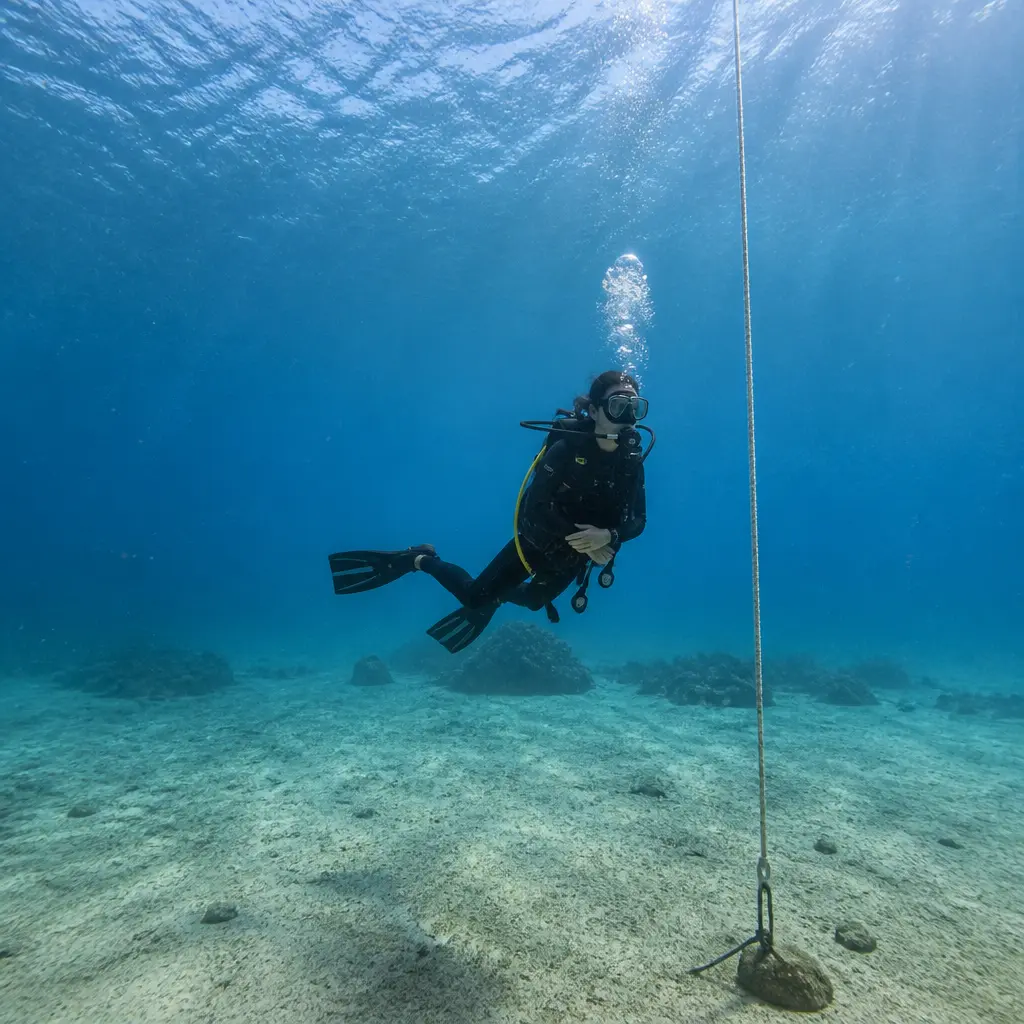
Recreational-diver breath-holding is the habit of stopping normal exhalation, tightening the throat, or “saving” gas during descent, ascent, exertion, or an equipment problem. It is among the most dangerous habits a diver can fail to correct because expanding trapped gas can injure the lungs even during a shallow ascent. The core rule is simple: breathe continuously, never hold the breath, and ascend at a controlled rate. This article explains why the habit persists, how it produces pulmonary barotrauma and arterial gas embolism, why buoyancy and stress make it worse, and how divers can replace it with practical training routines.
Recreational-Diver Breath-Holding Is a Preventable Risk
The entity-attribute pairing in this article is recreational diver—breath-holding habit. It describes a repeated behavior in which a diver interrupts normal regulator breathing or ascends with a closed glottis. Divers Alert Network defines pulmonary barotrauma as tissue injury caused when expanding gas damages the lungs, while the Professional Association of Diving Instructors teaches the closely related operational rule that divers should never hold their breath underwater.
The danger comes from pressure change rather than depth alone. According to NOAA’s diving physics guidance, pressure is approximately 2 atmospheres absolute at 10 meters of seawater and 3 atmospheres at 20 meters. As a diver ascends, the surrounding pressure falls and the air in the lungs expands. Under Boyle’s law, gas volume increases as pressure decreases. A diver who exhales normally allows that gas to escape; a diver who holds the breath can force expanding gas into vulnerable lung tissue.
The risk is not limited to deep technical dives. Divers Alert Network notes that lung-overexpansion injuries can occur during very shallow ascents, sometimes from only about 1.2 meters, or 4 feet, if a diver holds the breath. The Centers for Disease Control and Prevention also identifies drowning as a major preventable injury category, with thousands of fatal drownings occurring annually in the United States. Although not all drowning incidents involve scuba, the figures reinforce why a small breathing error can become an emergency when combined with panic, current, poor buoyancy, or loss of consciousness.
Continuous Breathing
Continuous breathing means maintaining a normal, relaxed breathing pattern through the regulator without deliberate pauses during ascent or descent. It does not mean breathing rapidly or taking unusually large breaths. A controlled inhale followed by a relaxed exhale is usually sufficient, with the exhalation continuing during the final portion of an ascent.
This category includes the related behaviors of breath-holding, skip-breathing, closed-glottis breathing, and forceful straining against a blocked airway. Skip-breathing is particularly deceptive because divers may view it as a gas-conservation technique. In reality, it can increase carbon-dioxide retention, produce headache or anxiety, and make the diver more likely to panic or lose control of buoyancy.
Pulmonary Barotrauma
Pulmonary barotrauma is pressure-related injury to the lungs. Expanding gas can overstretch or rupture alveoli, allowing air to enter the chest cavity or bloodstream. Possible consequences include pneumothorax, mediastinal emphysema, subcutaneous emphysema, and arterial gas embolism. Symptoms may include chest pain, coughing, bloody sputum, breathing difficulty, dizziness, confusion, weakness, or sudden loss of consciousness.
The mechanism is especially dangerous because it can develop during an otherwise ordinary ascent. A diver does not need to make a dramatic emergency ascent from great depth. A rapid rise near the surface, combined with a held breath, can create a substantial pressure differential. The Divers Alert Network and the Undersea and Hyperbaric Medical Society treat suspected arterial gas embolism or serious pulmonary barotrauma as medical emergencies requiring immediate oxygen, emergency evaluation, and recompression assessment when indicated.
Arterial Gas Embolism
An arterial gas embolism occurs when gas enters the arterial circulation and obstructs blood flow, potentially affecting the brain, heart, or other organs. It can resemble a stroke or cardiac emergency. Sudden neurological symptoms after surfacing—including weakness, numbness, difficulty speaking, confusion, seizure, or collapse—should be treated as a diving emergency rather than dismissed as fatigue.
The connection between breath-holding and embolism is why “I was only in shallow water” is not a reliable reassurance. Pressure changes are greatest proportionally near the surface. The final 10 meters of ascent represent a change from roughly 2 atmospheres absolute to 1 atmosphere, meaning the gas in a diver’s lungs can approximately double in volume if it cannot escape.
Why Recreational Divers Keep Repeating the Habit
The breath-holding habit usually develops from a combination of training gaps, anxiety, equipment discomfort, and poor buoyancy control. A diver may briefly stop breathing while looking at a camera, crossing a silty area, adjusting a mask, or attempting to slow an unwanted ascent. Repetition can make the pause feel normal even though it undermines the basic safety response.
Buoyancy-Control Errors
A diver with too much weight, insufficient practice, or poor trim may use the lungs as a fine-control device. The diver inhales to rise, holds the breath to stop rising, and exhales only after the problem has become pronounced. This creates a feedback loop: the held breath increases buoyancy, the ascent accelerates, and the diver holds the breath longer in an attempt to regain control.
Good buoyancy practice replaces that loop with small, deliberate adjustments. Divers should establish neutral buoyancy at the surface, check weighting in shallow water, keep the body streamlined, and use the buoyancy compensator for broad changes rather than relying on breath-holding. The best measure of improvement is not merely air consumption; it is the ability to hover while breathing normally.
Stress, Task Loading, and Panic
Stress narrows attention and encourages instinctive behaviors. When a mask floods, a fin strap breaks, visibility disappears, or a current pushes the diver upward, the diver may clench the airway before consciously recognizing it. Rapid breathing, breath-holding, and uncontrolled ascent can then reinforce one another.
A useful emergency sequence is stop, establish breathing, control buoyancy, signal the buddy, and solve one problem at a time. The sequence matters because it restores the behavior most likely to prevent lung injury: a functioning, continuous breathing pattern. Divers Alert Network safety guidance consistently emphasizes calm problem-solving, controlled ascent, and immediate access to emergency oxygen and medical support when a serious incident is suspected.
Gas Conservation and Skip-Breathing
Some divers skip breaths because they are worried about running low on gas. That strategy is counterproductive. Carbon dioxide can accumulate when ventilation is deliberately reduced, increasing the sensation of breathlessness and the urge to breathe rapidly. A diver who alternates between holding the breath and over-breathing may become less calm and less capable of making sound decisions.
Better gas management begins before entering the water: plan the maximum depth, expected duration, reserve pressure, ascent route, and response to an out-of-air emergency. Monitoring the pressure gauge at regular intervals is safer than manipulating breathing to make the cylinder last longer.
How to Replace Breath-Holding With a Safer Habit
Use a Breathing-and-Ascent Drill
During confined-water practice, a diver can rehearse a slow ascent while maintaining a relaxed inhale-and-exhale cycle. The exercise should be performed under qualified supervision, with adequate gas, a clear ascent path, and no attempt to simulate an emergency beyond the diver’s training. The objective is not to hold a precise breath pattern; it is to make continuous exhalation during ascent automatic.
- Establish neutral buoyancy and confirm normal regulator breathing.
- Begin a controlled ascent while looking upward and monitoring depth.
- Continue relaxed exhalation instead of closing the throat.
- Stop the drill if breathing becomes labored, buoyancy becomes unstable, or the diver feels anxious.
- Repeat only when the instructor or dive leader confirms that conditions remain safe.
Practice the Pre-Dive Safety Check
A pre-dive check should confirm that the regulator delivers gas comfortably, the alternate air source is accessible, the buoyancy compensator inflates and deflates, the release mechanisms are understood, and the buddy knows the planned signals. Equipment familiarity reduces the chance that a small malfunction will trigger an instinctive breath-hold.
The check should also include a personal question: “If I become stressed, will I continue breathing?” Stating the answer aloud converts a general rule into a specific behavioral commitment.
Recognize Symptoms After the Dive
Chest pain, unusual shortness of breath, persistent cough, bloody sputum, severe dizziness, confusion, weakness, numbness, or collapse after an ascent requires urgent medical attention. The diver should be removed from further diving, given emergency oxygen by a trained person when available, and connected with local emergency services and diving-medicine support. A suspected diving injury should not be minimized because the symptoms appear mild or improve temporarily.
The Practical Standard for Every Recreational Dive
The dangerous habit is not simply “breathing incorrectly.” It is treating breath-holding as an acceptable solution to buoyancy, stress, gas consumption, or equipment problems. Recreational-diver breath-holding can lead to pulmonary barotrauma and arterial gas embolism because expanding gas must be allowed to escape during ascent. Pressure doubles approximately between 10 meters and the surface, and documented diving guidance warns that injury can occur in water only a few feet deep.
The corrective habit is equally clear: breathe continuously, maintain neutral buoyancy, ascend slowly and under control, monitor gas before it becomes critical, and stop to solve problems rather than rushing upward. Divers should refresh these skills in a pool or controlled environment with a qualified instructor, especially after a long break, equipment change, illness, or stressful dive. Further reading from Divers Alert Network, NOAA, PADI, and the Undersea and Hyperbaric Medical Society can help divers build a safer breathing and emergency-response routine.
Sources: Divers Alert Network, Pulmonary Barotrauma and Arterial Gas Embolism, https://dan.org/health-medicine/health-resources/diseases-conditions/pulmonary-barotrauma/; National Oceanic and Atmospheric Administration, Diving Physics and Pressure, https://oceanexplorer.noaa.gov/edu/learning/7_cold/activities/pressure.html; Professional Association of Diving Instructors, Open Water Diver Course Materials, https://www.padi.com/education; Undersea and Hyperbaric Medical Society, Diving Medical Guidance and Emergency Care, https://uhms.org/resources/recompression-chamber-guidelines.html; Centers for Disease Control and Prevention, Drowning Prevention, https://www.cdc.gov/drowning/data-research/facts/index.html


